
We have another packed show for you this month. Megan tells us the latest news in astronomy including exciting news about the STEREO mission, the Nobel Prize for physics 2006, ice on the Moon, extrasolar planets, damage to the Faulkes Telescopes, the re-opening of Mt Stromlo and the future of the Hubble Space Telescope. Nick and Stuart talk to Robert Nemiroff about the great internet resource that is astronomy picture of the day. We find out about an exciting ESA/NASA mission that will attempt to detect waves in space-time (gravitational waves) using three spacecraft named LISA. We also get a spooky edition of Ask an Astronomer where Tim O'Brien tells Nick about the variable star Algol and Ian Morison tells us what we can see in the November night sky.

Robert Nemiroff's book Astronomy: 365 days published by Abrams
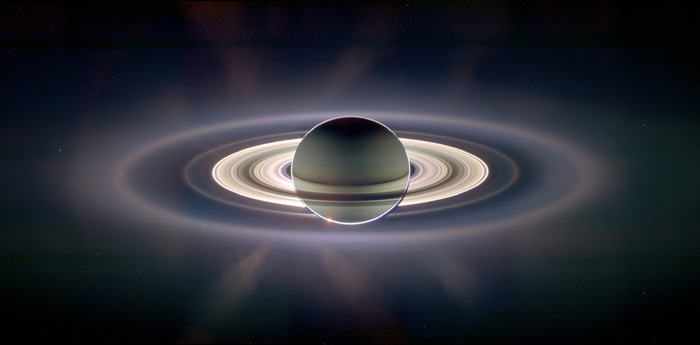
Saturn Occults the Sun. CREDIT: Cassini Imaging Team, SSL,JPL,ESA,NASA.
Show Links
The News
- MP3: Download this segment individually
- Nobel Prize for Physics 2006
- COBE Mission
- STEREO Mission
- Hubble finds 16 candidate extrasolar planets far across our Galaxy
- Article in the journal Nature about ice on the Moon.
- Faulkes Telescope Project
- Faulkes Telescope damage
- Mount Stromlo Observatory
- Hubble Space Telescope press release
Interview with Dr Oliver Jennrich (ESA)
- MP3: Download this segment individually
- The LISA space mission (ESA page)
- The LISA space mission (NASA page)
Interview with Dr Robert Nemiroff (APoD)
- MP3: Download this segment individually
- Astronomy Picture of the Day
- Eclipsed Earth seen from the Mir space station
- The Mosaic web browser
- Astronomy: 365 days (Abrams)
Ask an astronomer - Creepy Constellations
- MP3: Download this segment individually
- Algol on Wikipedia
The night sky for November
- MP3: Download this segment individually
- Ian Morison's Night Sky pages for November 2006
- HM Nautical Almanac Office: transit of Mercury
- NASA: transit of Mercury
- IMCCE Meteor Shower Ephemerides Server: Leonids 2006
Show Credits
| News: | Megan Argo |
| News in Chinese: | Dandan Xu |
| Notícias em Português: | Valerio Ribeiro |
| हिंदी समाचार: | Sanhita Joshi |
| Nouvelles en Français: | Neil Vaytet |
| اخبار به فارسى: | Mina Panahi and Mohammad Ebadinejad |
| Interview: | Nick Rattenbury talked to Dr Oliver Jennrich (European Space Agency) |
| Interview: | Stuart Lowe and Nick Rattenbury talked to Dr Robert Nemiroff (Michigan Technological University) |
| Ask an Astronomer: | Nick Rattenbury asked Tim O'Brien your questions |
| Night sky this month: | Ian Morison |
| Presenter: | David Ault |
| Editors: | David Ault and Stuart Lowe |
| Production Assistant: | Matt Strong |
| Cover Art: | Sombrero Galaxy (Hubble and Spitzer Space Telescopes) - NASA |
| Website: | Stuart Lowe |
| Intro/Outro Cast: | Amanda Fitzwater was the narrator, Mark Bruzee was HAL, Seth Adam Sher was Dave, Nick Rattenbury was Dave/himself, Tim O'Brien was himself |
| Cover art: | Sombrero Galaxy Credit: Hubble and Spitzer Space Telescopes/NASA |
 The News in Chinese [Duration 06:21]:
 Notícias em Português [Duration 06:24]:
 हिंदी समाचार [Duration 06:23]:
 Nouvelles en Français [Duration 07:13]:
 اخبار به فارسى [Duration 10:00]: