The last Jodcast of 2006 has arrived with Dave, Nick and Stuart all presenting via the wonders of the Internet. We start, as always, with a round up of the past month in astronomy which can now be downloaded in six languages if you feel like practicing your Chinese, English, Farsi, French, Hindi or Portugeuse! We talk to Cormac Purcell about the microwave equivalent of lasers (masers) that are found in space and discover what they can tell us about the evolution of stars. In Ask an Astronomer, Tim explains why the Moon often appears to be larger when near the horizon and Ian tells us what we can see in December's night sky. As we were feeling festive this month, we suggest some great, free, astronomy software (Stellarium, Google Earth and Celestia) that nobody should be without. We've also replaced our usual sci-fi style intro/outro with a Jodcast pantomime. It's certainly a long way from Kansas...
Show Links
- Google Earth (explore our planet)
- Stellarium (explore the night sky)
- Celestia (explore the Universe)
The News
- MP3: Download this segment individually
- Transit of Mercury seen by NASA/ESA's SOHO spacecraft
- The Large Millimeter Telescope in Mexico
- The ATLAS detector at CERN
- NASA press release about the loss of Mars Global Surveyor
- Society for Popular Astronomy meteor section
Interview with Dr Cormac Purcell (Jodrell Bank Observatory)
- MP3: Download this segment individually
- The Mopra telescope
- The Australia Telescope Compact Array
Ask an astronomer - Big Moon
- MP3: Download this segment individually
- The Moon Illusion
- Moon illusion on Wikipedia
The night sky for December
- MP3: Download this segment individually
- Ian Morison's Night Sky pages for December 2006
Show Credits
| News: | Megan Argo |
| News in Hindi: | Sanhita Joshi |
| Nouvelles en Français: | Neil Vaytet |
| Notícias em Português: | Valerio Ribeiro |
| News in Chinese: | Dandan Xu |
| Interview: | Nick Rattenbury talked to Dr Cormac Purcell (Jodrell Bank Observatory) |
| Ask an Astronomer: | Nick Rattenbury asked Tim O'Brien your questions |
| Night sky this month: | Ian Morison |
| Presenters: | David Ault, Nick Rattenbury and Stuart Lowe |
| Editor: | David Ault |
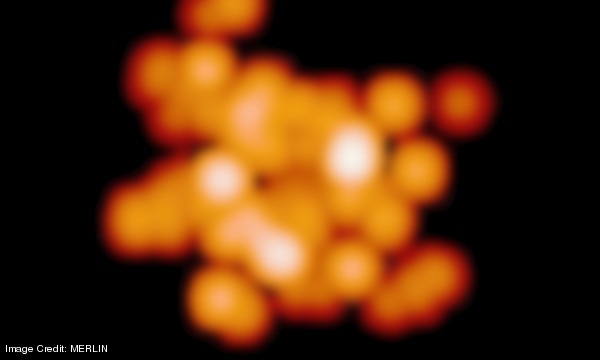
| Cover Art: | A 22GHz image showing maser observations of RT Vir taken over ten weeks (MERLIN) |
| Website: | Stuart Lowe |
| Intro/Outro Cast: | Ian Morison was the Narrator, Nick Rattenbury was the Great and Powerful Pod, Megan Argo was Dorothy, Tim O'Brien was Tim Man, Stuart Lowe was Stuart-crow, David Ault was Cowardly Dave, Mark Bruzee was HAL and Seth Adam Sher was Dave |
| Intro script: | Steve Anderson and David Ault |
| Cover art: | A 22GHz image showing maser observations of RT Vir taken over ten weeks Credit: MERLIN |
 News in Hindi [Duration 05:43]:
 Nouvelles en Français [Duration 04:48]:
 Notícias em Português [Duration 03:32]:
 The News in Chinese - December 2006 [Duration 05:00]: