Jodcast RSS Feed
CURRENT SHOW > May 2008
 
Launch Astronomy Media Player

Review us

Have you listened to the Jodcast? If so, we would love it if you would review the Jodcast on iTunes.

The Jodcast is supported by:
Science and Technology Facilities Council

October 2007

It is the 50th anniversary of the launch of Sputnik and we're going back to 1957 with the last part of our Audience with Sir Bernard Lovell. In the rest of the show we talk to Professor Albert Zijlstra about planetary nebulae, get the latest news and find out what we can see in the night sky. We also introduce our new Facebook group and mention the Big Space Draw.

The news - October 2007

In the news this month: star formation seen in galactic tail, Magellanic clouds are new visitors, new results from Mars Reconnaissance Orbiter and pulsars were discovered earlier than thought.

Interview with Prof Albert Zijlstra

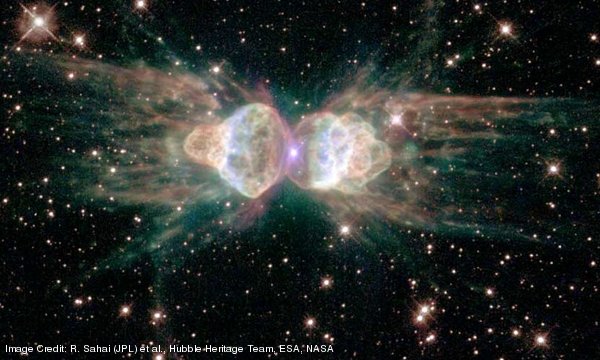
Nick talked to Prof Albert Zijlstra about planetary nebulae.

An Audience with Sir Bernard Lovell (Part 3 of 3)

In August 2007 Jodrell Bank hosted "An Audience with Sir Bernard Lovell". In the last part of the series Sir Bernard talks to Tim O'Brien about the observatory from the start of October 1957 onwards.

The night sky for October 2007

Ian Morison tells us what we can see in the night sky from northern latitudes during October 2007. To the south in early evening is the beautiful region of the Milky Way containing both Cygnus and Lyra. Below is Aquila. The three bright stars Deneb (in Cygnus), Vega (in Lyra) and Altair (in Aquila) make up the "Summer Triangle". East of Cygnus is the great square of Pegasus - adjacent to Andromeda in which lies M31, the Andromeda Nebula. To the north lies "w" shaped Cassiopeia with Perseus below. Jupiter may just be seen in the south-west as the Sun sets as the month begins. At the beginning of the month it is just 20 degrees above the horizon an hour after sunset so is seen in the twilight - by month's end this will have dropped to 12 degrees. At the very beginning of October, Mercury might just be visible in evening sky about 20 to 30 minutes after sunset. Mercury passes between the Earth and the Sun on October 23rd at what is called "inferior conjunction" before it becomes visible in the pre-dawn sky. Mars, is in Gemini during October and is now rising around 10 pm. Its disk is just 9.7 arc seconds across and it shines at magnitude -0.1 at the beginning of October. During the month its brightness increases to magnitude -0.6 and it angular size increases to 12 arc seconds. Venus is now shining brightly dominating the eastern pre-dawn sky! It was at its very brightest in late September but still shines at magnitude -4.7 - the brightest object in the sky apart from the Moon! Viewing it with a telescope will reveal a 38% illuminated crescent. As October begins, Saturn, 3.6 degrees down to the lower left of the star Regulus in Leo, is seen in the pre-dawn sky. They gradually move apart and by the end of the month Saturn is around 6 degrees to the lower left of Regulus. Around October 21st is the Orionid Meteor Shower. While the Orionids are not one of the most spectacular showers, with peak rates around 20 per hour, they are interesting as it is believed that the meteors originate from Comet Halley. It is worth looking out for them for a week around the 21st as the shower is long lived. They will best be seen in the hours before dawn when Orion is high in the southern sky. On October 7th before dawn you can see Venus, Saturn and the waning crescent Moon; perhaps the best sky-scape this month. Depending on your location, you may see an occultation of Regulus from ~ 05:19 until ~ 06:00. In the early hours of October 3rd, the Moon, just after third quarter, will lie close to the planet Mars and the cluster M35 - all in the constellation Gemini. October is another good month to observe the planet Uranus with binoculars, a small telescope or even your unaided eye! On October 11th, the night of new moon, Uranus, with a magnitude of 5.8, lies just over 3 degrees up and to the left of the 4th magnitude star Lambda Aquarii. To the left of the tiny constellation Triangulum is the star Algol in Perseus. It is an eclipsing binary and every 2.87 days its brightness drops by more than a magnitude and then rises again. In October you can watch this happen over a period of hours around 22:50 UT on the 21st and 19:38 UT on the 24th.

Show Credits

News:Megan Argo
Interview:Nick Rattenbury and Prof Albert Zijlstra
Interview:Tim O'Brien and Sir Bernard Lovell
Night sky this month:Ian Morison
Presenters:David Ault, Nick Rattenbury and Stuart Lowe
Editor:Stuart Lowe
Cover Art:Planetary Nebula Mz3: The Ant Nebula. CREDIT: R. Sahai (JPL) et al., Hubble Heritage Team, ESA, NASA
Intro/outro script:Dave Ault
Intro/outro voices:Jon Morss as Marty and Doc
Intro/outro mixing:Jon Morss
Website:Stuart Lowe