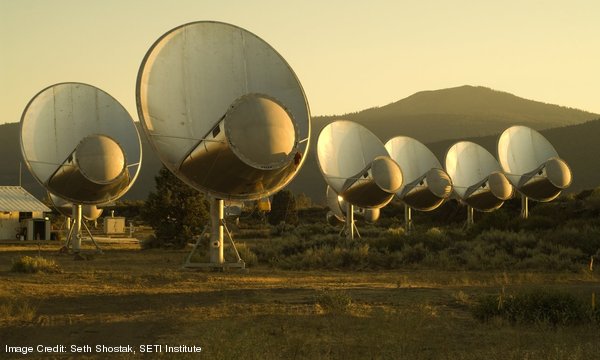
Is there intelligent life out there? In this issue we find out about the search for extra-terrestrial intelligence and ask listeners to complete our second survey. We find out if space has the ingredients necessary to make a beer and get the low down on ESO's Catch a Star competition. We also get the latest news from Megan and find out what you can see in the night sky during November from Ian.
Show Links
The news - November 2007
- MP3: Download this segment individually (low and high bandwidth versions)
- Comet 17P Holmes outburst - SkyandTelescope.com
- JAXA's Suzaku (ASTRO-EII) spacecraft
- NASA's Chandra X-ray Observatory
- Asteroid named after George Takei - StarTrek.com
Interview with Dr Jill Tarter (Center for SETI Research)
- MP3: Download this segment individually (low and high bandwidth versions)
- SETI Institute
- SETI@Home
- Stardust@Home
- Einstein@Home
- The Drake Equation
- Optical SETI
- Allen Telescope Array
- ATA Image Gallery including M31 and M33
- Podcast: Are We Alone?
- Dr Jill Tarter
- The Carl Sagan Portal
Interview with Dr Douglas Pierce-Price (ESO)
- MP3: Download this segment individually (low and high bandwidth versions)
- Catch a Star 2008
- Catch a Star 2008 Gallery
- The Very Large Telescope Project, Paranal, Chile
Interview with Dr Andrew Walsh (James Cook University)
- MP3: Download this segment individually (low and high bandwidth versions)
- CraftBrewer Radio Podcast
The night sky for November 2007
- MP3: Download this segment individually (low and high bandwidth versions)
- Ian Morison's Night Sky pages for November 2007
Show Credits
| News: | Megan Argo |
| Interview: | Dr Jill Tarter and Nick Rattenbury |
| Interview: | Dr Douglas Pierce-Price and Stuart Lowe |
| Interview: | Dr Andrew Walsh and Stuart Lowe |
| Night sky this month: | Ian Morison |
| Presenters: | David Ault, Nick Rattenbury and Stuart Lowe |
| Editor: | Stuart Lowe |
| Segment Guest Presenter: | Edward Boyce |
| Intro/outro script: | Tom Stitzer and Dave Ault |
| Intro/outro voices: | Tom Stitzer, David Ault and Nick Rattenbury |
| Website: | Stuart Lowe |
| Cover art: | The Allen Telescope Array Credit: Seth Shostak, SETI Institute |