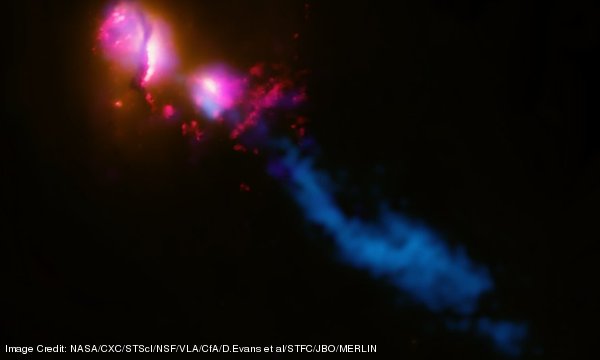
Happy New Year and welcome to the first show of 2008. This time we find out all about highly magnetised neutron stars - magnetars. We find out how observations with X-ray telescopes are allowing us to measure star quakes and probe the insides of magnetars. As it is the start of a new year we describe a selection of our favourite astronomical images from 2007 and tell you what to expect in the coming months. As always we also get the latest news from Megan and Ian tells us what we can see in the night sky.
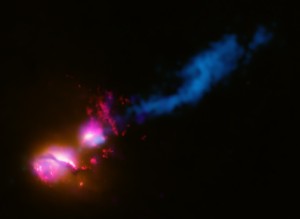
The jet from the black hole in 3C321 striking the edge of another galaxy. Credit: NASA/CXC/STScI/NSF/VLA/CfA/D.Evans et al/STFC/JBO/MERLIN
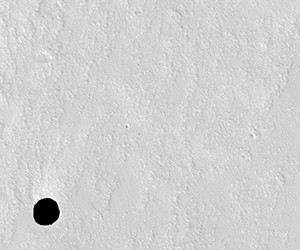
Initial image of hole on the side of Arsia Mons, Mars seen by the HiRISE instrument on Mars Reconnaissance Orbiter. CREDIT: NASA/JPL/University of Arizona
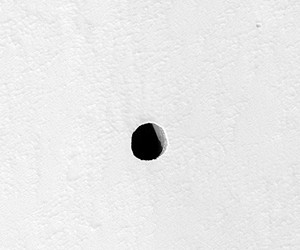
Later image of hole on the side of Arsia Mons showing the side of the pit illuminated. CREDIT: NASA/JPL/University of Arizona
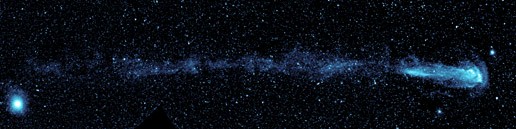
Ultraviolet mosaic from NASA's Galaxy Evolution Explorer showing the tail left by the star Mira CREDIT: NASA/JPL-Caltech
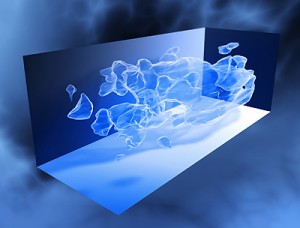
A three dimensional map of dark matter in the universe CREDIT: NASA, ESA and R. Massey (California Institute of Technology)
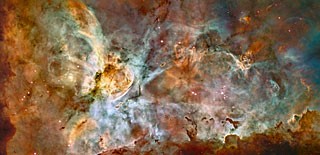
Hubble's view of the Carina Nebula CREDIT: NASA, ESA, N. Smith (University of California, Berkeley), and The Hubble Heritage Team (STScI/AURA)
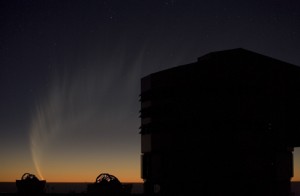
Comet McNaught seen from Paranal CREDIT: ESO
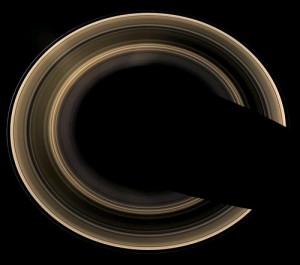
Saturn's rings seen from above with Saturn removed. CREDIT: NASA/JPL/Space Science Institute
Show Links
- Our interview with Jocelyn Bell Burnell (June 2007)
- The first of our interview series with Bernard Lovell (September 2007)
- AstroFest 2008
The news - January 2008
- MP3: Download this segment individually (low and high bandwidth versions)
- Chandra: 3C 321
- ESA's Venus Express
- Wikipedia: Venus Express
- New Scientist: The Moon is younger than thought
- International Astronomical Union
Favourite images of 2007
- MP3: Download this segment individually
- UKIRT Infrared Deep Sky Survey zoomable mosaic.
- APoD: Mars and Orion Over Monument Valley
- Ask an astronomer from April 2007 talking about dark matter maps
- The Moon bounce in July 2007
The night sky for January 2008
- MP3: Download this segment individually (low and high bandwidth versions)
- Ian Morison's Night Sky pages for December 2007
- Stellarium planetarium software
- Comet 8P/Tuttle
Show Credits
| News: | Megan Argo |
| Interview: | Dr Anna Watts and Nick Rattenbury |
| Interview: | David Ault, Stuart Lowe, Tim O'Brien and Nick Rattenbury |
| Night sky this month: | Ian Morison |
| Presenters: | David Ault, Stuart Lowe, Tim O'Brien and Nick Rattenbury |
| Editors: | Stuart Lowe and David Jones |
| Intro/outro script: | Dave Ault |
| Intro/outro voices: | Mark Kilfoil as the Voice Over, David Maciver as Nick; M Sieiro Garcia as Lou; Fedrick Rhoads as Terry; Zach Bradley as The Kid; Eric Busby as The Pizza Guy; Sally Wiget, Steve Anderson, Alasdair Stuart, M Sieiro Garcia, Eleiece Krawiec, David Maciver and Fedrick Rhoads as the Crowd |
| Website: | Stuart Lowe |
| Cover art: | Composite image of 3C321 Credit: NASA/CXC/STScI/NSF/VLA/CfA/D.Evans et al/STFC/JBO/MERLIN |