October 2008
You don't see the same universe twice. This month Jim Cordes tells us [20:12 - 34:25] about the recently discovered class of pulsars which emit their pulses in a very intermittent way. Jim also tells us about future searches for transient astrophysical objects and his use of the Arecibo radio telescope. As usual we get the latest news from Megan [01:14 - 08:37] and find out what you can see in the northern night sky from Ian [38:10 - 52:55].
- October 2008 MP3: Download the whole show (low and high bandwidth versions)
The news - October 2008
In the news this month: first beam for the LHC, dwarf galaxies dominated by dark matter, Hubble detects a peculiar new transient, and the Cepheid Galactic Internet
- The news - October 2008 MP3: Download this segment individually (low and high bandwidth versions)
- LHC first beam
- astro-ph: The Least Luminous Galaxy: Spectroscopy of the Milky Way Satellite Segue 1
- Yale: Astronomers Discover Most Dark Matter-Dominated Galaxy in Universe
- Nature: Weird freaky burst
- astro-ph: Discovery of an Unusual Optical Transient with the Hubble Space Telescope, Barbary, K. et al
- astro-ph: SCP06F6: A carbon-rich extragalactic transient at redshift z~0.14, B.T. Gaensicke, A.J. Levan, T.R. Marsh, P.J. Wheatley
- Nature: 'Galactic internet' proposed
- astro-ph: The Cepheid Galactic Internet, John G. Learned, R-P. Kudritzki, Sandip Pakvasa, A. Zee
- Cepheid Variables
Interview with Prof James Cordes (Cornell)
Pulsars - pulsating neutron stars - are bizarre astrophysical objects. Since 1967 we've discovered over 2000 of them by searching for the periodic pulses they emit. Jim Cordes tells us that some neutron stars are not so regular and can be quite intermittent. We discuss some of the ideas that might explain these intermittent pulsars as well as future telescopes that will look for intermittent events in the sky.
- Interview with Prof James Cordes (Cornell) MP3: Download this segment individually (low and high bandwidth versions)
- Jim Cordes at Cornell
- Large Synoptic Survey Telescope
- Murchison Widefield Array
- Jodcast (January 2006) interview with Michael Kramer about pulsars
- Jodcast (June 2007) interview with Jocelyn Bell Burnell about the discovery of pulsars
- Jodrell Bank astronomers find new type of star
- Arecibo Radio Telescope
The night sky for October 2008
Ian Morison tells us what we can see in the night sky from northern latitudes during October 2008. A sunspot has been seen on the Sun which could herald the start of the next solar cycle. Setting towards the west as night-fall begins are Cygnus, Lyra and Aquila. Towards the south in the mid evening is the square of Pegasus. Up to its left is the constellation Andromeda and up to the left of that is Perseus. With binoculars, between Cassiopeia and Perseus, you should find a fuzzy bright area of the sky called the double cluster - two, close, open clusters. Below the Square of Pegasus is Pisces and we also have Cetus over to the lower left. Orion and Taurus are becoming visible in the early morning. Jupiter is still seen low in the south west as night begins. Saturn is now visible in the pre-dawn sky and will get higher in elevation as the month progresses. Mercury passes between us and the Sun on the 6th October and reaches western elongation on the 22nd October. Mars is too close to the Sun to observe. Venus is very low in the west after sunset and is gradually moving, in angle, away from the Sun. Around 26th October Saturn, Mercury and the Moon will make a very nice skyscape in the hours before dawn. Vesta is the second most massive object in the asteroid belt after Ceres( now termed a dwarf planet) but it is the brightest. In the early morning hours of October, when Taurus the Bull in high in the eastern sky, it may be found crossing the head of Cetus the whale. In the late evening, the galaxy M31 in Andromeda is visible in the south-east.Though the Orionids are not one of the most spectaculer showers with peak rates around 20 per hour, they are interesting as it is believed that the meteors originate from Comet Halley. It is worth looking out for them for a week around the 21st as the shower is long lived. They will best be seen in the hours before dawn when Orion is high in the southern sky. October is another good month to observe the planet Uranus - perhaps for the first time - with binoculars, a small telescope or even your unaided eye! For those in the southern hemisphere, Jupiter is low in the west just above the heart of the Milky Way (Sagittarius). High in the south - almost overhead - are the Large and Small Magellanic Clouds which appear as clouds in the sky. Just to the right of the Small Magellanic Cloud is a misty blob - 47 Tucanae - which is one of the two most spectacular globular clusters visible in the southern hemisphere. Andromeda is low in the north. Finally, Vesta is also visible up and to the left of Pegasus.
- The night sky for October 2008 MP3: Download this segment individually (low and high bandwidth versions)
- Ian Morison's Night Sky pages for October 2008
- NASA's Ulysses
- NASA's SOHO
Show Credits
| News: | Megan Argo |
| Interview: | Prof James Cordes and Nick Rattenbury |
| Night sky this month: | Ian Morison |
| Presenters: | David Ault, Nick Rattenbury and Roy Smits |
| Editors: | Roy Smits |
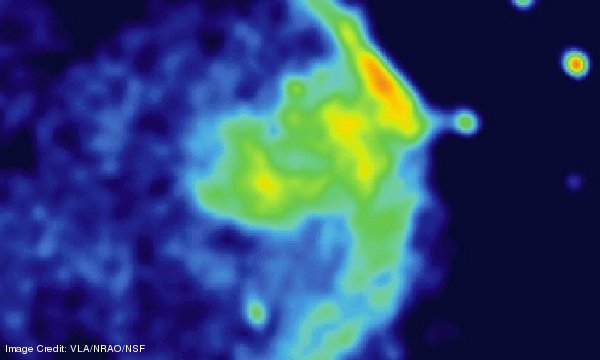
| Cover Art: | A VLA image of Pulsar B1757 and the radio supernova remnant G5.4-1.2, collectively known as 'The Duck' CREDIT: VLA/NRAO/NSF www.nrao.edu/pr/2000/duck/ |
| Intro/outro: | David Ault |
| Website: | Stuart Lowe |


