In the show this time, Dr Anthony Rushton tells us about the EVN and microquasars, and Prof Anne Zabludoff talks about blobs. As always, Megan brings us the latest astronomical news and we hear what can be seen in the October night sky.
The News
In the news this month:
Stars less than roughly nine times as massive as the Sun are generally not massive enough to end their lives as supernovae, evolving instead to become what is known as asymptotic giant branch stars. During the main part of its life, a star fuses hydrogen at high temperatures and pressures in the core, forming helium. When the hydrogen is exhausted, the core contracts and the temperature increases, until the helium begins to burn. Once the helium in the core is also used up, the core once again shrinks, while the helium in a shell surrounding the core begins to burn. At this stage in a star's life, it is known as an asymptotic giant branch (or AGB) star. One class of AGB star are carbon stars, so-called because their spectra show numerous lines corresponding to the presence of carbon (a carbon to oxygen ratio of greater than one). From chemical models, such stars were predicted to have little or no water in their atmospheres, so the unexpected discovery in 2001 (Nature 412 160 2001) of water in the spectrum of a carbon star known as IRC+10216 was attributed to the possible presence of a population of orbiting comets or other icy bodies which were heated as the star brightened. Now, in a study published in Nature on the 2nd of September, an international team have provided evidence which is further challenging our understanding of the chemistry in these stars. Using the Herschel infra red satellite, the team again observed IRC+10216 and found not just one spectral line corresponding to water, as in the previous observations, but dozens both in the infra red and sub-millimetre parts of the spectrum. While the 2001 detection implied the presence of water in a comparatively cool region, some of the newly observed lines correspond to temperatures of around 1000 K, implying water is present in the inner regions of the star's envelope, a highly surprising result. As well as strong evidence for many other molecules, including carbon monoxide, hydrogen cyanide and ammonia, the observations show the first evidence in the envelope of a carbon-rich AGB star of para-H2O, water molecules in which the spins of the protons are opposite instead of aligned (as in ortho-H2O). The temperature of the water vapour implied by the observations suggests that the water is present in the inner part of the envelope surrounding the star, ruling out the suggestion that the water is present only in the outer envelope due to a population of cometary or cometary-like bodies. The likely mechanism, according to the authors, is the penetration of ultra violet photons deep into the stars atmosphere due to a clumpy structure in the outer layers. These photons could cause the dissociation of molecules such as carbon monoxide and silicon oxide which contain oxygen atoms. Water then forms through simple reactions with hydrogen in the surrounding stellar atmosphere. This model fits the observational results, including the higher than expected abundance of other molecules such as ammonia, but requires a very clumpy circumstellar medium, highlighting that there is still a lot to learn about the chemistry and atmospheres of these evolving stars.
Most supernovae occur in other galaxies at vast distances from the Earth, making detailed observations (required to understand the physics) difficult. The closest supernova explosion in modern times was that of SN1987A which was observed in the Large Magellanic Cloud, a dwarf galaxy orbiting the Milky Way, on the 23rd of February 1987 and was the brightest seen from Earth since Kepler's supernova of 1604. Events like these are important to understand in the context of galaxy evolution as supernovae inject large amounts of both energy and heavy elements into the surrounding environment and can trigger further star formation. Located just 160 thousand light years away, SN1987A provided a perfect opportunity to study a supernova in detail and to watch the transition from supernova to expanding remnant as the shock wave interacts with the surrounding gas of the interstellar medium. Numerous studies of SN1987A have been made using the Hubble Space Telescope from its launch in 1990 until the failure of the Space Telescope Imaging Spectrograph in 2004. Now, a team led by Kevin France of the University of Colorado have used instruments on the refurbished telescope to compare the shock emission in 2010 with data taken in 2004. The fast-moving material ejected by a supernova moves outwards from the site of the explosion, interacting with the surrounding material of the interstellar medium and creating a blast wave, also known as a forward shock, which propagates outwards. The pressure of the layer of hot shocked gas created by the forward shock also creates another shock wave that travels back into the ejected material, known as a reverse shock. This simple structure is disturbed in real supernovae by variations in the density of the surrounding gas. In the case of SN1987A, the shock expanded until it hit a relatively dense equatorial ring of material, thought to be the result of a mass-loss event on the progenitor star which occured some 20,000 years before the explosion. This ring of dense maerial reflected the shock back into the debris. Over the years, observations have shown this 1.3 light year diameter ring develop into a series of thirty bright knots, and the new observations with the HST show that the emission from these shocked regions is still increasing while the maximum velocities of material in the shocks is decreasing. The results, published in Science magazine on September 24th, are consistent with theoretical predictions describing how supernovae interact with their immediate galactic environment. It is expected that over the next few years these individual shocked hotspots will grow and merge together, eventually forming one giant glowing circle. The new data, together with further observations monitoring the continued evolution of the SN1987A remnant as it develops, will help determine how the energy deposited in such explosions alters both the dynamics and chemical composition of the galactic environment.
And finally: The Einstein@Home distributed computing project has discovered a new pulsar, the first discovered by volunteer computing efforts. Like the SETI@Home project, Einstein@Home uses the idle time of a vast network of home computers to search through datasets for specific signals. In this case, the primary goal is the detection of gravitational waves from rapidly spinning neutron stars, but since 2009 some of the computing time has also been used to search data from the 305-metre Arecibo radio telescope in Puerto Rico, looking for the signatures of pulsars. On July 11th 2010, pulsar J2007+2722 was discovered by a computer using the Einstein@Home software. Follow-up observations were carried out with telescopes around the world, including the Green Bank Telescope in the US, the Lovell Telescope at Jodrell Bank in the UK, the Effelsberg radio telescope in Germany, and Arecibo in Puerto Rico. The observations confirmed that J2007+2722 has a period of 24-milliseconds, rotating more than 40 times a second. It is located at an approximate distance of 17,000 light years, but has no known x-ray or gamma-ray counterpart and is not associated with either a supernova remnant or globular cluster, making it somewhat unusual.
Interview with Dr Anthony Rushton
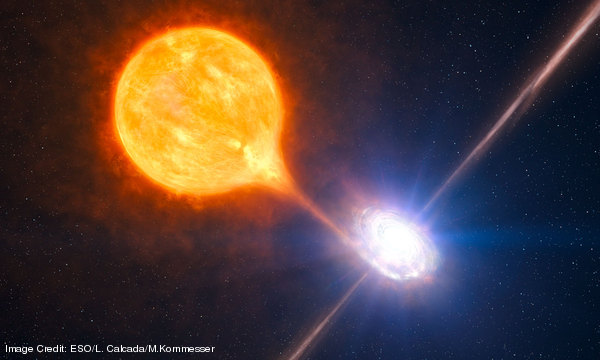
Dr Anthony Rushton (ESO) tells us about the EVN and his research studying microquasars.
Interview with Prof Anne Zabludoff
Prof Zabludoff works at the University of Arizona and speaks here on her research into Lyman alpha 'blobs' at high redshift. Ann Zabludoff's research focuses principally on the evolution of the baryonic and dark matter components of galaxies and larger-scale structures, analyzing the environments of strong gravitational lenses to provide new constraints on the expansion rate of the Universe, the dark energy, and the dark matter halo characteristics of galaxies.
The Night Sky
Northern Hemisphere
Ian Morison tells us what we can see in the northern hemisphere night sky during October 2010.
There is a very nice skyscape at this time of year. Fairly high up in the south-west is the group of constellations Cygnus the Swan, Lyra the Lyre and Aquila the Eagle. Their respective brightest stars, Deneb, Vega and Altair make up the Summer Triangle. Down to the left of Cygnus lies the constellation Delphinus. Over towards the east, and due south in the mid evening, is the square of Pegasus. Below the square of Pegasus is the head, or circlet, of one of the two fish that make up Pisces. To the lower left is Cetus the Whale and down to the right is Aquarius. Up to the right of Pegasus lies Perseus and up to its right is the contellation Cassiopeia. Between Perseus and Cassiopeia lies the double cluster.
The Planets
- Jupiter is superb this month. It has risen in the east as soon as the Sun has set and dominates the eastern sky at magnitude -2.9. It is visible for much of the night and takes 10 hours to rotate so it is almost possible to observe a full rotation. It is still missing the southern equatorial belt but this makes the great red spot more obvious than usual. The Galilean moons are visible with a telescope.
- Saturn was in line with the far side of the Sun on the 1st October so will not be visible until the end of the month. On the 31st it will be visible just before dawn and will be one degree from the star Gamma Virginis, appearing to form an uneven double. The rings are now opening out to 8 degrees.
- Mars and Venus are both just visible as the Sun is setting, very low above the horizon. On the 9th Venus will be very close to a thin crescent Moon. Do not look near the Sun before it has set!
- Mercury will be just visible above the eastern horizon before dawn at the beginning of the month. Best to wait until next Spring.
Highlights
- Comet Hartley passes through this month. It comes closest to the Earth on the 20th but this coincides with the full Moon so it is best observed at the beginning of the month. It moves across the sky from Cassiopeia at the beginning of the month to the double cluster on the 9th then will be close to Capella in Auriga on the 20th.
- Mons Piton is an isolated lunar mountain 2.3 km high and 25 km across. Its height can be determined by measuring the shadow it casts on the lunar surface.
- The Orionid meteor shower peaks around the 21st but unfortunately coincides with the full Moon.
- The Andromeda galaxy (M31) is visible in the south-east. Start at the upper left star of the square of Pegasus. Move in the direction of the top line of the square to a bright star, tilt round to the right and up slightly to another bright star. Turn 90 degrees right to another relatively bright star and continue in the same direction to the fuzzy glow of Andromeda. If Pegasus is not up, regard the right hand part of Casseopeia as an arrow. Follow this down to Andromeda. With dark skies and binoculars, details of the galaxy such as the arms should be visible.


Southern Hemisphere
John Field from the Carter Observatory in New Zealand tells us what can be seen in the southern night sky during October 2010.
Spring is a time of change for the southern night sky. The winter constellations Scorpius and Saggitarius are descending in the west. The summer constellations Orion and Ursa Major are rising in the east.
The Planets
- Jupiter rises in the east.
- Uranus will be close to Jupiter and visible with a binoculars or a small telescope.
Highlights
- Star clusters are visible with binoculars or a telescope. Open clusters are found in the plane of the galaxy while globular clusters form a halo around the galaxy. Many clusters are visible in the southern sky. The most well known are Omega Centauri which appears to be a fuzzy star close to Beta Centauri, and 47 Tucanae close to the Small Magellanic Cloud. Other clusters visible in the southern sky include NGC6397 in Ara, M4 and M80 in Scorpius, and M20 and M22 in Sagittarius.
- Spring evenings in the southern hemisphere are the best time to see the zodiacal light, visible as a faint conical glow after sunset. Scan along the western horizon after sunset in a dark location when there is little or no Moon and look for a change in brightness from the darker background sky.
Odds and Ends
World Space Week is this month, from the 4th to the 10th of October. Check the website for details of events in over 55 countries.
The Cassini spacecraft has captured a rather strange picture of two of Saturn's moons.
Work has started on the construction of the new visitors' centre at Jodrell Bank. The ground breaking at the site was on the 20th of September and the centre is due to be completed in Summer 2011. The visitors' facilities at Jodrell Bank will be somewhat limited during the construction period so please check the website before visiting.
Ian Morison recommends the book "Turn Left at Orion" by Guy Consolmagno and Dan M. Davis.
Show Credits
| News: | Megan Argo |
| Interview: | Dr Anthony Rushton and Megan Argo |
| Interview: | Prof Anne Zabludoff and David Ault |
| Night sky: | Ian Morison and John Field |
| Presenters: | Megan Argo, David Ault and Jen Gupta |
| Editors: | Jen Gupta, David Ault, Megan Argo and Claire Bretherton |
| Intro/outro concept/editor: | David Ault |
| Segment voice: | Lizette Ramirez |
| Website: | Stuart Lowe and Jen Gupta |
| Cover art: | Artist's impression of a stellar black hole binary system. Credit: ESO/L. Calçada/M.Kornmesser |
[an error occurred while processing this directive]