In this show we talk to Dr Karen Masters about LOFAR and Galaxy Zoo, Dr Haley Gomez talks about dust in galaxies and Dr Stephen Serjeant tells us about star-forming galaxies and strong gravitational lensing. Dr Tim O'Brien answers your astronomical questions, and we report on some odds and ends from the world of astrophysics.
Interview with Dr Karen Masters
Dr Karen Masters (Institute of Cosmology and Gravitation, University of Portsmouth) works on LOFAR, a low frequency radio telescope array, largely located in the Netherlands but with stations located in other European countries, including a station in the UK at Chilbolton. Karen describes some of the computing challenges of the project, and the exciting science that will come out of this telescope. Karen is also involved with Galaxy Zoo and describes some new results on the nature of red spiral galaxies, and the latest Galaxy Zoo project using images from the Hubble Space Telescope.
Interview with Dr Haley Gomez
Dr Haley Gomez works at Cardiff University studying dust in galaxies. In this interview, Haley explains what cosmic dust is and where it is found. She also talks about the Herschel Space Observatory and how it is being used to understand more about dust in the Universe.
Interview with Dr Stephen Serjeant
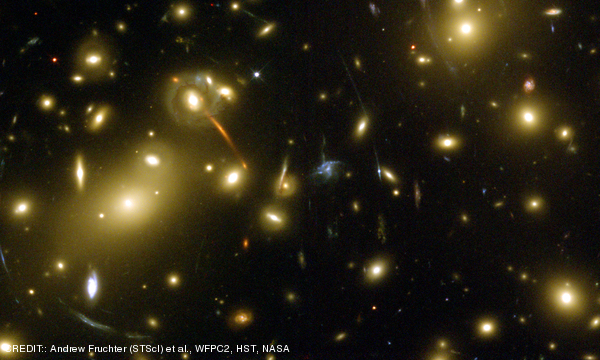
Dr Stephen Serjeant (The Open University) works on extragalactic surveys of star-forming galaxies, as well as acting as a consultant for the popular TV show Bang Goes the Theory. In this interview, Stephen talks about his work on the Herschel ATLAS; including the star formation history of quasar host galaxies and the properties of strongly gravitationally lensed sub-millimetre galaxies.
Ask an Astronomer
Dr Tim O'Brien answers your astronomical questions:
- The first question is from Greg. He wants to know about the relationship between mathematics and astronomy. In particular he wants to know whether, as either a professional or a hobbyist, if one lacks mathematics will a pursuit of astronomy end in a frustrated exercise?
- Willie Wilson has several questions about the structure of our Galaxy. Is the plane of our solar system the same as the plane of the Milky Way? Why is there a central bulge in our Galaxy? Is there matter - gas, stars, etc. - lying above and below the galactic plane and, if so, how is this matter distributed?
- Jim Omans from Virginia writes in to say: "While landing in a plane on a very windy day, I began to wonder if galaxies wobble. Many galaxies rotate - ours does. Do galaxies also pitch, yaw and roll as they move through space?"
- The next question is from Ian Kennedy: "If the Universe is expanding and everything is moving apart, how come galaxies collide?"
- David Entwistle wants to know how we decide on the arrangement of individual elements (e.g. aerials, dishes, etc.) in the new radio telescope systems such as LOFAR and the SKA.
- Finally, Mark Randles asks "When can we expect to begin to get pictures of Pluto taken by the New Horizons space probe which are of better quality and resolution than the ground-based and Hubble pictures so far obtained?"
Odds and Ends
NASA satellite Gravity Probe B, which was launched in April 2004 after over 40 years of development, confirmed two crucial points in Albert Einstein's general theory of relativity. Using fast-spinning gyroscopes, the instrument measured how the tug of Earth's gravity and the planet's spin distort space and time in its cosmic neighbourhood.
A Polish farmhouse received a direct hit from outer space on the 30th of April, when a meteorite crashed through its roof and smashed into several pieces on the ground. The largest fragment weighed around 1kg, and was still warm when it was found. One end of the rock appeared to have been moulded into a rounded shape during its descent through the Earth's atmosphere, allowing it to avoid vaporisation. Although no-one was injured by this rare event, there is at least one documented case of a meteorite striking a human being (non-fatally).
INTECH, near Winchester in Hampshire, is doing a day of events for the deaf and hard of hearing on the 22nd of May, including signed and subtitled planetarium shows.
On the 15th of June a total lunar eclipse will be visible from the UK. The Museum of Science and Industry in Manchester is holding a series of talks, demonstrations and planetarium shows (with some of the Jodcasters and friends), before heading over to Cloud 23 in the Hilton Hotel to observe the moon rising in eclipse. It would be great to see some of you there.
Show Credits
| Interview: | Dr Karen Masters and Megan Argo |
| Interview: | Dr Haley Gomez and Jen Gupta |
| Interview: | Dr Stephen Serjeant and Libby Jones |
| Ask An Astronomer: | Dr Tim O'Brien |
| Presenters: | Melanie Gendre, Libby Jones and Mark Purver |
| Editors: | Mark Purver, Melanie Gendre, Jen Gupta, Libby Jones and Tim O'Brien |
| Producer: | Libby Jones |
| Segment Voice: | Liz Guzman |
| Website: | Stuart Lowe and Libby Jones |
| Cover art: | A Hubble Space Telescope image of galaxies in the cluster Abell 2218. This cluster gravitationally lenses, magnifies, and brightens the light from very distant galaxies. CREDIT:: Andrew Fruchter (STScI) et al., WFPC2, HST, NASA |
[an error occurred while processing this directive]