December 2025 : Feeling the Cosmic Pulse
Episode Audio
Feeling the Cosmic Pulse. In this month's episode, Jessy and Barbara had the opportunity to speak to Dr Kai Schmitz of the University of Munster about the first results from the Pulsar Timing Array and \ how this could affect our understanding of early universe cosmology. Louisa and Sohini provide an end of year round up for the Jodcast, talking about the highlights of 2025 and where we are going in 2026. In our Jodbite, Louisa & Phoebe speak to PhD student Kathryn Edmondson about her work detecting and characterizing exoplanets.
The News
What a Missing Signal Tells Us About Alien Worlds
When the James Webb Space Telescope detected potential biosignatures in the atmosphere of K2-18 b last year, the discovery sparked intense debate. Here was a sub-Neptune exoplanet 124 light years away, possibly harboring methane, carbon dioxide, and even dimethyl sulfide which is a gas produced by phytoplankton on Earth. But before we get too excited about alien life it’s necessary to understand if this planet's atmosphere can even survive the harsh environment from the host star!A team of researchers turned to the Karl G. Jansky Very Large Array to find out, searching for radio emissions from K2-18's host star. Over twelve weeks, they listened at multiple frequencies between 2 and 10 gigahertz, hoping to detect the telltale radio signatures of stellar magnetic activity. What they found was remarkable in its absence, they found nothing at all.
The researchers searched for both steady radio emission from the star's corona and brief bursts that might indicate stellar flares or even auroral activity from the planet's magnetosphere. They found neither, placing strict upper limits on the system's radio output. If K2-18 produces flares, they must be rare and weak compared to typical M dwarf stars.
Japanese spacecraft faces a massive challenge from a house-sized asteroid
Hayabusa2 is an asteroid sample-return mission operated by the Japanese state space agency JAXA. Launched in December 2014, it has already visited near-Earth asteroid 162173 Ryugu (Ree-u-goo) for a year and a half to collect samples and return them to Earth in December 2020.
Now, its mission has been extended through to at least 2031 where it will rendezvous with the small, rapidly-rotating asteroid 1998 KY26. New observations using observatories across several continents, including the European Southern Observatory's Very Large Telescope show that the asteroid is a mere 11 meters across and spinning twice as fast as previously thought. The discovery adds complexity to Hayabusa2’s 2031 mission but also heightens scientific interest.
James Webb Space Telescope spots a gassy baby galaxy throwing a tantrum in the early universe
A baby galaxy is throwing one heck of a tantrum, and it's shaking up our understanding of the earliest galaxies.Using JWST, astronomers recently observed a young galaxy named SXDF‑NB1006‑2 which existed when the Universe was less than 500 million years old. What makes it remarkable is its frantic pace: forming stars at about 165 times the mass of our Sun every year — that’s over 16 times the star-formation rate of our own Milky Way.
But this high-energy growth comes with a cost. Massive stars produce intense outflows and supernovae that eject gas at speeds of more than 500 km/s — three times the galaxy’s escape velocity. Once that gas is gone, it’s gone for good. The team estimates that SXDF-NB1006-2 will exhaust its gas supply in only a few hundred million years, transforming into a more quiescent galaxy thereafter.
Interview with Kai Schmitz
Dr. Kai Schmitz from the University of Münster talks to us about the initial results from the Pulsar Timing Array. The PTA uses changes in the length of pulses emanating from local pulsars to probe the Cosmic Gravitational Wave Background — a still theoretical equivalent to the Cosmic Microwave Background, but now with gravitational waves. He highlights his team's initial results, hinting that there is strong evidence suggesting it exists, and tells us how this could lead to further insights into lingering questions in early-universe cosmology.
Jodbite with Kathryn Edmondson
In this Jodbite, Louisa speaks with Kathryn Edmondson, a PhD student here at the University of Manchester working with Eamonn Kerins on the detection and characterisation of Exoplanets
End of Year Round Up
2025 has been a busy year for the podcast, so Louisa & Sohini sit down to discuss what we’ve been up to, highlights from this year’s episodes and what we can look forward to for 2026.
Show Credits
Interview : Kai Schmitz, Jessy Marin & Barbara Cabrales
Presenters : Emily Walls, Sohini Dutta, Josh Bishop
Editors : Jamie Incley, Jordan Norris & Josh Bishop
Jodbite : Kathryn Edmondson & Louisa Mason & Phoebe Ryder
Show Editor : Alex Walls
Show Lead : Louisa Mason
Website : Lily Correa Magnus
Producer : Lily Correa Magnus
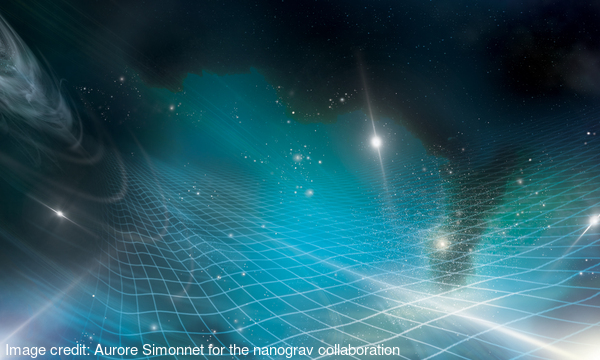
Cover Art : Artist’s interpretation of an array of pulsars being affected by gravitational ripples produced by a supermassive black hole binary in a distant galaxy. CREDIT:Aurore Simonnet.