March 2026 : Into the Cosmic Void
Episode Audio
Into the Cosmic Void. This month, we have a double cosmology interview special where Sohini and Jamie chat with Marika Asgari about her work on cosmic shear with KiDS and the future of KiDS, and her favourite models of dark matter and dark energy. Whilst Jamie talks with Leon Koopmans about his work on LOFAR, why LOFAR as an instrument will still have its own niches even in the post-SKA era.
The News
First results published from the ALMA survey to Resolve exoKuiper belt Substructures (ARKS)
One of ALMA’s Large Programmes published their first results last month. The program, called the ALMA survey to Resolve exoKuiper belt Substructures (ARKS), had the goal of imaging 24 debris discs around nearby stars to get detailed statistical information about the radial and vertical extent of the structures and to also measure the gas content within these discs. Debris discs are material around stars that appear after these have finished forming, meaning these discs are not related to the nebulae that the stars and their planets formed out of. Instead, they form as a result of objects orbiting the stars, such as comets, asteroids, and planetesimals, colliding with each other.The new observations from ARKS show that the discs are not all simple disc or ring structures. Some have complex ring structures that indicate possible gravitational interactions with planets, while others look puffy or clumpy or asymmetric.
Dark Matter as an Alternative to a Central Black Hole in the Milky Way
A recent study, revisits the long standing interpretation of the Milky Way’s central mass. Sagittarius A*is generally understood to be a supermassive black hole of roughly four million solar masses. The new work explores an alternative possibility: that the same gravitational effects could arise from a compact core of fermionic dark matter rather than a black hole.
The researchers model a dense dark matter core embedded within an extended halo and test whether this configuration can reproduce two key observational regimes. First, they examine the orbits of the S stars, which move at high velocities within a fraction of a light year of the galactic center. Their calculations show that a sufficiently dense dark matter core can, in principle, generate the gravitational field needed to match these stellar trajectories. Second, they compare the model’s outer halo to the Milky Way’s rotation curve, including Gaia data, and find that the same dark matter distribution can account for the galaxy’s large scale dynamics.
Future high precision measurements of stellar orbits, along with improved imaging of the galactic center, will be important for distinguishing between these scenarios. As with many dark matter studies, the work is exploratory, but it contributes an additional perspective to ongoing efforts to understand the structure and evolution of the Milky Way.
Interview with Marika Asgari
Sohini and Jamie chat with Marika Asgari about her work on cosmic shear, dark matter, and dark energy.
Interview with Leon Koopmans
Jamie chats with Leon Koopmans about his work on LOFAR and why LOFAR as an instrument will still have its own niches even in the post-SKA era.
Show Credits
Interview1 : Marika Asgari and Sohini Dutta and Jamie Incley
Interview2 : Leon Koopmans and Jamie Incley
Presenters : Emily Walls and George Bendo
Editors : Josh Bishop, Thea Hauxwell, and Jordan Norris
Website : Lily Correa Magnus
Producer : Lily Correa Magnus
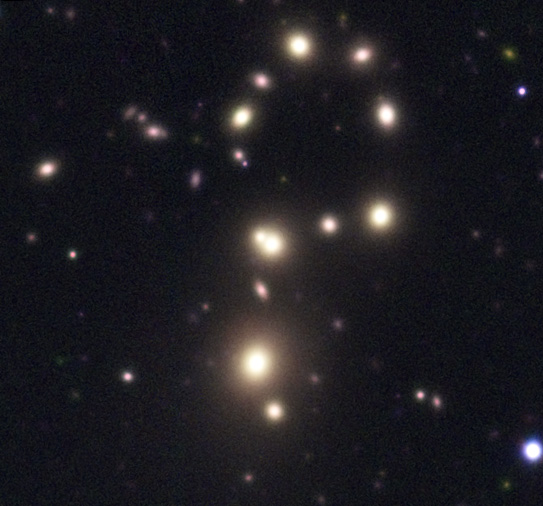
Cover Art : A set of galaxies arranged like a question mark. CREDIT:Dominik Klaes, Katy Romer, Alex Tudorica, KiDS.