May 2026 : Astronomy in the North
Episode Audio
Astronomy in the North. In this month’s episode, we talk to Jane Hurley from RAL Space about how the space sector shapes daily life. Then, from our live event at the Chester Astronomy Society in March, we listen to Jodcasters Phoebe and Josh talk about their research.
The News
Artemis II mission success
Artemis II marked NASA’s first crewed journey to the moon’s vicinity in more than 50 years, completing a nine‑day lunar flyby that tested the systems needed for future lunar landings. The mission launched on April 1, 2026, carrying four astronauts - Reid Wiseman, Victor Glover, Christina Koch, and Jeremy Hansen - aboard the Orion spacecraft atop the Space Launch System rocket. After orbiting Earth and verifying life‑support and navigation systems, the crew traveled more than 252,000 miles from home, setting a new human distance record before looping around the moon and capturing rare views of its far side.
During the flyby, the astronauts collected hundreds of gigabytes of data, photographed lunar terrain unseen by human eyes, and shared vivid descriptions of the experience—coining the term “Moon Joy” to capture their awe. Their work also included testing Orion’s radiation protection and manual piloting capabilities, essential steps toward future surface missions.
Artemis II splashed down safely in the Pacific Ocean on April 10, 2026, confirming the spacecraft’s readiness for the next phase of the Artemis program: returning humans to the lunar surface and eventually pushing onward to Mars.
link to the mission
Using Medieval Japanese poetry and buried trees to help predict space weather
Solar activity such as flares and coronal mass ejections can occasionally trigger Solar Proton Events (SPEs) in which high energy particles are flung towards the Earth at up to 90% the speed of light. Inside the safety of Earth’s magnetic field these appear as benign auroras, but can leave astronauts exposed to deadly particle radiation. In 1972, a string of SPEs occurred between the Apollo 16 and 17 missions.
Researchers from the Okinawa Institute of Science and Technology have been using medieval records to guide ultra-precise carbon-14 measurements of buried asurano trees in Northern Japan. High energy particles that manage to get through the Earth’s magnetic field at the poles collide with atmospheric gases, forming carbon-14 compounds which circulate in the atmosphere and are incorporated into organic materials. These small carbon-14 fluctuations can be detected but as the analysis is time-consuming, researchers need to be signposted to which organic objects to look into. This new technique provides a basis for detecting sub-extreme SPEs which while still hazardous are around 10-30% the size.
The diary of an influential Japanese courtier and poet Fujiwara no Teika (1162–1241) described “red lights in the northern sky over Kyoto” in February 1204 CE, indicating an aurora event that accompanies an SPE. Dendroclimatic studies (comparing patterns of tree-ring growth associated with regional climate) are used to precisely date the trees from this period. Asunaro wood from this period was unearthed in the northern Aomori Prefecture to be analysed and a specific sub-extreme SPE event was pinpointed to between the winter of 1200 and the spring of 1201 CE. This study helps close gaps in the historical record of solar activity, thereby improving our understanding of unpredictable and hazardous events like SPEs.
Interview with Jane Hurley
At the Appleton Space Conference in December, Phoebe and Louisa chat to Dr Jane Hurley on her role as Head of Researchers at RAL Space. She talks to us about the many ways the space sector impacts our everyday lives, the responsibilities of research and technology development and what working at RAL is like.
Live Recording at Chester Astronomy Society
For this month's Jodbite we have two more talks that were recorded live at Chester Astronomical Society's meeting in February. First up we have Josh Bishop talking about his journey to starting a PhD at Manchester and his work using MeerKAT to study galaxy evolution. Then we have Phoebe Ryder talking about the history and recent revival of radar astronomy at Jodrell Bank.
Show Credits
Interview : Jane Hurley, Phoebe Ryder and Louisa Mason
Presenters : Emily Walls and Louis Hurrey
Editors : Phoebe Ryder, Josh Bishop and Louisa Mason
Show Editors :Jordan Norris
Show :Louisa Mason
Website : Lily Correa Magnus
Producer : Lily Correa Magnus
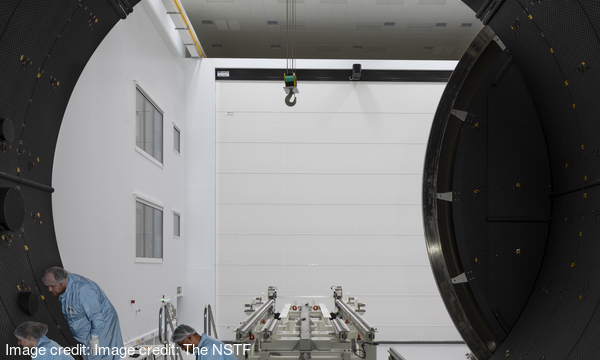
Cover Art : The NSTF's large space test chamber. CREDIT:RAL Space.