July 2026 : Teaching Machines the Cosmos
Episode Audio
Teaching Machines the Cosmos. In this month's episode, we talk to Dr Seshardi Nadathur from the Institute of Cosmology and Gravitation at the University of Potsmouth about his work in cosmology. Then, from the University of Nottingham we talk to Dr Maggie Lieu about her endeavours to use machine learning in her work on galaxy clusters. Also this month, Josh and Louis interview attendants of the Euclid-UK and LSST:UK Meetings.
Interview with Seshardi Nadathur
Sohini and Jamie chat with Seshadri Nadathur about his work on Cosmology, primarily understanding cosmological tensions using DESI data in combination with existing probes.
Interview with Maggie Lieu
Bárbara talks to Maggie Lieu (aka SpaceMog on youtube) from the Uni of Nottingham about her path into astronomy. Using galaxy clusters to understand cosmology and the structure of the Universe, and how machine learning can help astronomers in the age of big data.
Jodbite with Euclid-UK and LSST:UK Meeting Attendees
Josh and Louis take the Jodcast on the road (well, down the road) to the Euclid-UK and LSST:UK Meetings 2026 held here at the University of Manchester! We ask conference attendees about their experiences in astronomy, their favourite results and the number one thing they are looking forward to in the future of LSST and Euclid.
The News
Magnetic push and pull
Scientists have combined multiscale observations to shine a light on how magnetic fields can guide the way that stars form!The team pointed 3 different instruments at the G33.92+0.11 cloud located 7k pc (or roughly 23 kly) from earth. G33 is a particularly interesting region because it's a complex which is pretty thin and that we view face on so we have a clear top down view of what is happening there. The system consists of giant filaments several parsecs long – tens of light years – that are converging towards a massive central hub forming what we typically call a hub-filament system. In that hub we've observed spiral like arms feeding two massive star forming regions where we spotted 28 baby stars distributed both along the spiral-like structures and within the central cores.
What makes this study special is that it's essentially the first time that we've been able to follow the same magnetic fields from the cloud scales down to the scale of individual streamers! They combined observations from the polarimeter on the James Clerk Maxwell Telescope, the ACA and ALMA to see how the structure of the magnetic fields change from the approximately 5 pc down to around 4000 au. That's a change in scale of over 250 times smaller! The magnetic field lines appear bent into broad U-shapes, as though the flowing gas has grabbed hold of them and dragged them inward. The moving large scale gas strengthened and bent the fields to the point where they are strong enough to regulate the flow of gas in the smaller scales and forcing it to stay compact leading to stars forming within the streamers.The team also propose a new way of estimating magnetic field strength. By measuring how sharply the field lines curve, they can estimate the magnetic tension force and infer how the field strength changes across different scales.
This can all sound a little abstract to you so If you want to learn more about how interstellar magnetic fields affect the way that stars form and how we observe and measure them give a listen to the march 2024 episode where Dr. Kate Pattle explains it in great detail.
Neutral Atomic Hydrogen in a Star-forming Galaxy 7 Billion Years Ago
Neutral atomic hydrogen (HI) has long been used as one of our main tracers for the evolution of galaxies. And up until recently we were only able to directly observe it within the local Universe! A team have been able to see this gas up to 7 billion years ago by gravitational lensing.
HI is our premier tracer for the evolution of galaxies, as it is the raw fuel for star formation. So anything that disrupts or changes the HI content of a galaxy will have a knock on effect on its ability to keep making new stars. We also use HI to look into the environments of galaxies. A galaxy's HI disc extends much much further out than the optical disc you would see looking at it with your eyes. So by looking into this gas we can start to determine whether galaxies evolve through nature (whether that's due to processes within themselves) or nurture (due to interactions with other galaxies and the environment).
HI is abundant in galaxies, but its 21-cm emission is intrinsically faint. In the nearby Universe the signal is strong enough to detect directly, but at larger distances it becomes extremely challenging to observe. Although limited, some techniques do exist, for example stacking which is where we combine many individual faint galaxies to get a detection that pushes further in the past. However, this team led by scientists in South Africa, the UK and Germany have been able to see this faint gas at 7 billion years due to gravitational lensing! Gravitational lensing is where you have a massive object in the foreground, like a galaxy cluster, that bends light from objects behind it. This light can then be detected and is very often a different shape, or in the case of this work, amplified.
By looking at the HI content of galaxies being strongly lensed this team were able to produce a HI detection from a galaxy 7 billion years ago! This was only possible because they were using MeerKAT (sadly not the animals) radio interferometer that is super sensitive. This is a breakthrough result in this field and will allow astronomers to start investigating the evolution of galaxies halfway to cosmic noon which was 10 billion years ago where we have very little understanding of galaxies' evolution and their environments.
Show Credits
Presenters : Josh Bishop and Jessy Marin
Editors : Jamie Incley, Jessy Marin and Louisa Mason
Website : Lilia Correa Magnus, George Bendo & Phoebe Ryder
Producer : Phoebe Ryder
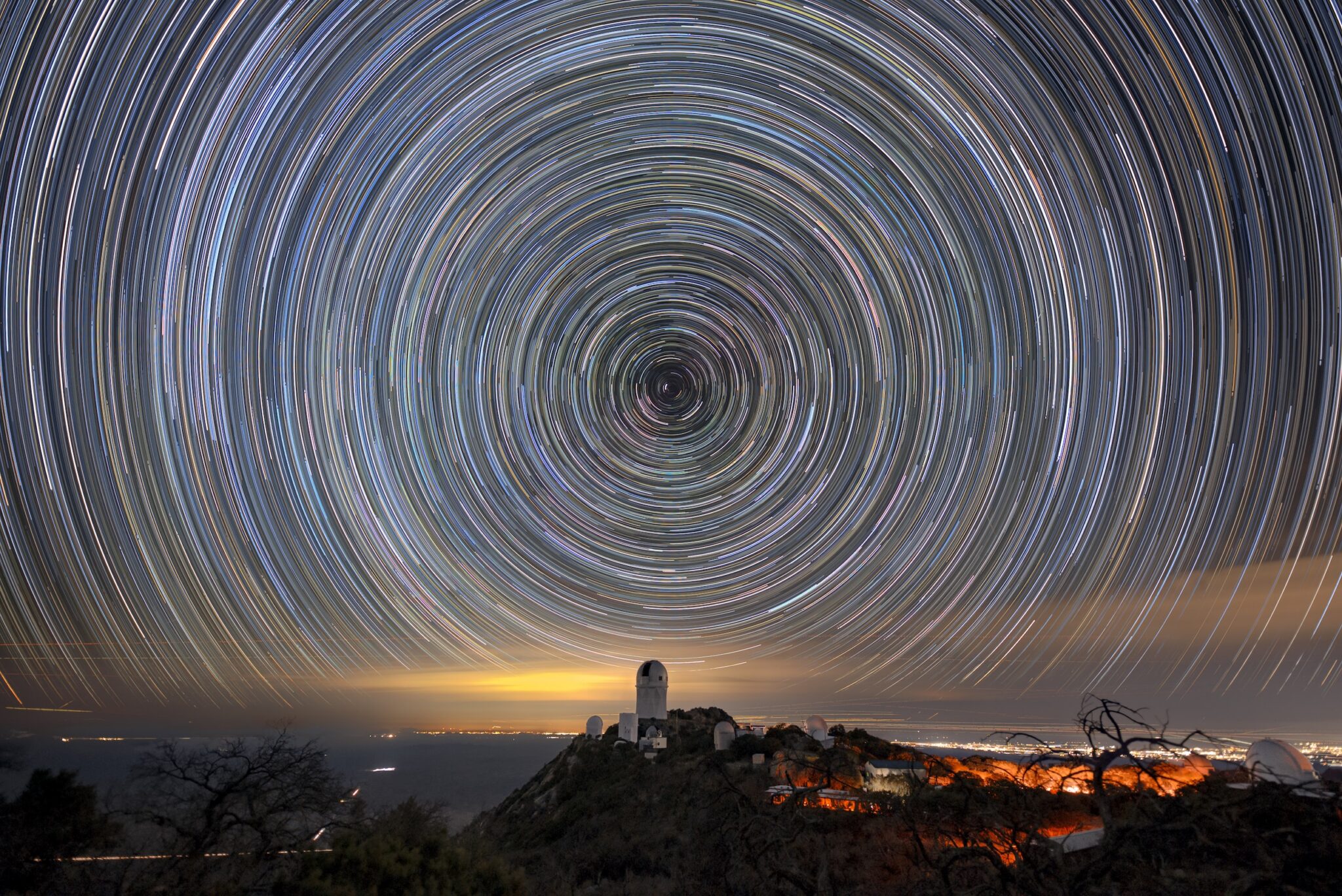
Cover Art : Star trails over the Mayall Telescope that houses DESI. CREDIT:Luke Tyas/Berkeley Lab and KPNO/NOIRLab/NSF/AURA