November 2026 : Explosive Stars, Less Explosive Planets
Episode Audio
In this month’s episode, we talk to Jane Greaves about finding phosphene on Venus and her work on PEBBLES. We also talk about searching for transients with Conor Omand. Finally, we talk about extragalactic science with attendees at the latest Extragalactic Meeting jointly held by University of Manchester, Liverpool John Moores university and Lancaster university.
The News
The Highest-z FRB Ever Detected, Found by MeerKAT and JWST
This detection was first made by South Africa’s MeerKAT radio telescope and the University of Manchester’s very own Professor Ben Stappers worked on this project.A “Fast Radio Burst” (FRB) is exactly what it sounds like, a very quick burst of radio emission that comes from an unknown origin. There are various ideas as to what causes these radio bursts, but we are not 100% sure as to their exact progenitors. Only a very few FRBs have been identified at redshifts greater than 1, so finding this FRB at a potential redshift of 2 was very exciting. This FRB was first discovered on the 4th of March 2024, but its exact host (and thus redshift) were initially unknown.
Later follow-ups with the James Webb Space Telescope (JWST) confirmed its host, placing it at a redshift of z=2.1, confirming it as the highest-z FRB ever detected. What’s particularly exciting about this host galaxy is that it has a low stellar mass, yet a high star formation rate, making it likely to be quite a young galaxy. This implies that the source of the FRB itself is thus likely to be a young “magnetar”, which is a rapidly spinning, incredibly magnetic neutron star. This is truly such an exciting new discovery, made by a collaboration of scientists across the globe with different telescopes.
Francis Halzen wins the 2026 Nobel Prize in Physics for his work with IceCube
IceCube detects neutrinos, often called ghost particles, because they barely interact with matter and can travel across the universe almost undisturbed. To detect them, IceCube uses over 5,000 sensors buried deep in Antarctic ice. When a neutrino interacts with the ice, it can produce a faint blue flash of light, which these sensors capture.
In 2013, IceCube discovered high-energy neutrinos originating beyond our solar system. What makes this remarkable is that neutrinos allow us to study extreme cosmic environments that ordinary telescopes cannot fully reveal. IceCube has essentially opened a new window into the universe, allowing us to do astronomy without relying on light alone.
University of Southampton asks citizens to find black holes!
Astronomers are asking for your help to find black holes hiding in our own galaxy. Researchers at the University of Southampton have launched a citizen science project called Black Hole Hunters, run through Zooniverse.Only around 70 black holes in the Milky Way are currently known, but the team thinks there could be thousands more we haven’t spotted. The trouble is that black holes don’t give off light, so they’re hard to find. What the team looks for is the way a black hole’s gravity bends the light of a star orbiting it, an effect called gravitational self-lensing.They’ve used an AI system to sift through millions of locations in data from NASA’s TESS telescope, and turned the best candidates into simple graphs and animations. Volunteers review these and flag any patterns that stand out. You don’t need any astronomy background, just a phone, tablet or laptop.
So if you fancy hunting for black holes, search for ‘Black Hole Hunters’ on Zooniverse. I will also link the project page in our show notes.
Interview with Conor Omand
Louis and Josh talk to Conor Omand from Liverpool John Moores Univeristy about searching for transients and modelling superluminous supernovae as magnetar engines.
Interview with Jane Greaves
Louisa and Sohini interview Dr. Jane Greaves from Cardiff University on her work with PEBBLES, finding Phosphine on Venus, dealing with robust discussions, proposing risky science and more.
Soundbites from Extragalatic meeting
At the extragalactic meeting held jointly by The University of Manchester, Liverpool John Moores University and Lancaster University, jodcasters Josh, Lily and Louisa stopped attendees in the corridors, coffee queues, and poster sessions to find out their thoughts on high redshift extragalactic research and their favourite plots.
Show Credits
Interview : Conor Omand with Louis Hurrey and Josh Bishop and Jane Greaves with Louisa Mason and Sohini Dutta
Presenters : Sohini Dutta, Rashi Srivastava and Carys Gilbert
Editors : Emily Walls, Jaimee Greenwood and Rosa Roberts
Website : Lily Correa Magnus & George Bendo & Phoebe Ryder
Producer : Phoebe Ryder and Josh Bishop
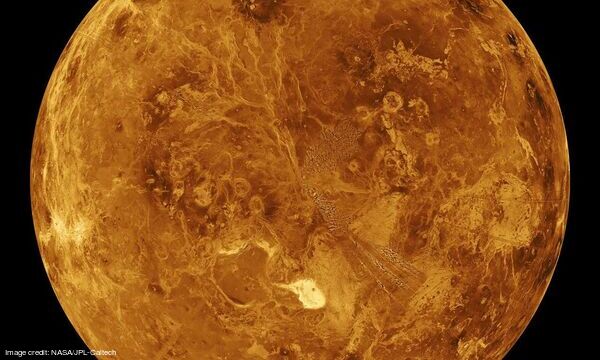
Cover Art : Computer Simulated Global View of the Northern Hemisphere of Venus From Magellan CREDIT:NASA/JPL-Caltech