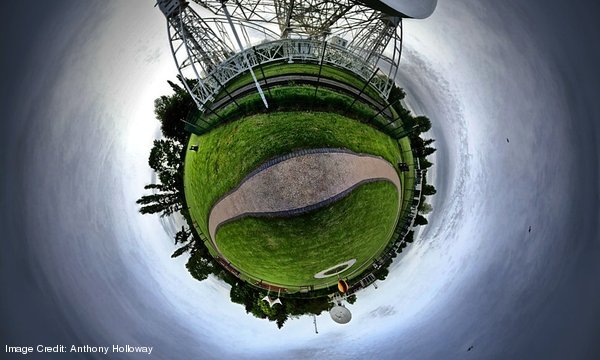
The Jodcast reaches its fifth birthday. To celebrate we talk to our first ever interviewee - Professor Michael Kramer - to find out what has happened in pulsar research over the past five years. As always, Megan brings us the latest astronomical news and we hear what can be seen in the northern hemisphere night sky during January. Unfortunately, this fifth anniversary edition is also Dave's final episode as a regular Jodcaster so we say goodbye and wish him well in his future projects.
The News
Most stars are largely composed of hydrogen nuclei. Fusion of these nuclei produces helium which, if the conditions in the stellar core are right, can then fuse to create heavier and heavier nuclei, up through the periodic table to iron. Elements heavier than iron are found in the atmospheres of stars however, but these elements are created not in stellar cores through the normal fusion process, but in the outer layers of massive stars or in the highly energetic environments of supernova explosions. Measuring the abundances of various chemicals in stellar atmospheres can lead to an understanding of the chemistry and history of a star. Now, a team of astronomers have found a star with unusually large amounts of several heavy elements. Hot subdwarfs are a class of small star near the end of their lives. The team were investigating why the class of helium-rich hot B subdwarfs have far less hydrogen in their outer layers than other, similar stars. Using the 3.9-metre Anglo-Australian telescope at Siding Springs in New South Wales, Australia, the astronomers looked at the optical spectrum of one particular B subdwarf, located some 2000 light years away from the Sun. What they found were signatures of several chemicals that would normally be expected to appear in the atmosphere of such a star, but the spectra also showed several strong features that were less easy to identify. Modelling of spectral features from various elements at the high temperatures found in subdwarf atmospheres showed that the lines were due to the elements zirconium, yttrium, strontium and germanium, at abundances between one and ten thousand times normal. This is the first detection of such high abundances in this type of star, so what causes such a strong detection? These chemicals are all heavier than iron, so are not produced in normal fusion processes in stellar cores. They are known to be created in a process known as slow neutron capture in the outer envelopes of large so-called Asymptotic Giant Branch stars. One suggestion for the apparent abundances seen here is that the material could have been dredged up from inside the star, but this requires the star to contain a very large amount of these heavy elements, with no clear mechanism for how they were created or acquired, since there is no evidence of a nearby Asymptotic Giant Branch star which could have donated such material. Another theory is that a combination of settling due to gravity, upward movement via radiation and convection, together with chemical diffusion, could lead to the formation of cloud-like layers in the stars atmosphere. Different cloud layers would contain larger amounts of different chemicals, with the surrounding atmosphere being corresponding deficient. This would explain the observed strong abundances of chemicals such as zirconium, without requiring an additional source of material or an unusual evolutionary pathway.
Most exoplanets detected are found indirectly, either through the apparent wobble of the parent star caused by the gravitational pull of orbiting planets, or the dimming of a star as a planet passes in front of it, blocking out some of the stars light. Some planets, however, have been detected through direct imaging. Now, a group have directly detected a fourth planet in a system already known to contain three massive planetary bodies. The detection of these planets was made in the infra red part of the spectrum, where hot objects shine brightly. The planets in this system formed only recently (less than 100 million years ago) so are still warm, and the three planets already known all have wide orbits, making them easier to spot over the much brighter central star. The new planet, designated HR 8799e, is orbiting the star with a period of roughly 50 years and is much closer than the the other planets in the system, separated from the star by just 14.5 times the distance between the Earth and the Sun, a distance known as the astronomical unit. The images were made using the Keck telescope in Hawaii and use a technique known as angular differential imaging which allows the bright central star to be subtracted from the image, allowing the much fainter planets to be seen. This planetary system resembles a scaled up version of the outer planets in our own solar system, with each of the four known planets several times more massive than Jupiter, and belts of debris located at distances from the star where the temperatures are similar to those in the more familiar asteroid and Kuiper belts around the Sun. More than 500 extra solar planets are now known, but this particular discovery is natable because it poses problems for theories of planetary formation. HR 8799 is the only known system where multiple giant planets orbit at distances greater than 25 astronomical units. Outer giant planets are thought to form by fragmentation of the debris disk surrounding a young star, but the newly discovered planet orbits HR 8799 at a distance where the disk would have been neither cool enough or rotating slowly enough for fragmentation to happen. The other prevailing model of planetary formation is that a core of solid material forms and accumulates material from the surrounding cloud. HR 8799e is too close to the star for fragmentation to be the formation mechanism, while the other gas giants in the system are too far away for accumulation to have been the cause. Because of the similarities of the planets, neither mechanism can explain the formation of the entire planetary system. It could be that the planets were all formed much further out than their current locations, and then migrated inwards towards the star, or formed much closer in and then migrated outwards to their current locations, but both of these theories also have their problems. While large planets like these are the easiest to spot, it may be that there is also a population of smaller, rocky planets located closer to the star, which future developments in technology could allow us to detect.
And finally: Scheduled to perform a manoeuvre on December 7th that would take it into orbit around Venus, Japan's Akatsuki spacecraft malfunctioned and will now have to wait for another opportunity to enter orbit. Launched on May 20th 2010, the probe carried a variety of instruments to investigate the planet's atmosphere and was scheduled to enter orbit around Venus on December 7th following a 12-minute burn of the orbital manoeuvring engine. Data from the spacecraft indicated that the burn started on time but, after a blackout due to the probe passing behind the planet, communications were not restored when expected. Since the engines only fired for three minutes instead of the twelve required to enter orbit, the probe missed the planet and will now continue on in orbit around the Sun. A series of images taken as the spacecraft passed the planet shows that the scientific instrumentation appears to be functioning as expected. The Japanese space agency, JAXA, are hopeful that by placing the probe in hibernation to minimise battery use they can prolong Akatsuki's life long enough that it may be able to enter orbit in six years when its current orbital path once again takes it close to the planet.
Interview with Professor Michael Kramer
Dr Michael Kramer was the first Jodcast interviewee five years ago, when he was a lecturer and pulsar researcher at Jodrell Bank Observatory. Now a professor and one of the directors of the Max Planck Institute for Radio Astronomy in Bonn, Germany, he heads his own group there as well as maintaining links with Manchester. In this interview he revisits the double pulsar system he originally spoke about, telling us what progress has been made in its investigation over the last five years and why one of the pulars is not currently visible. He also talks about the ongoing effort to detect gravitational waves using pulsar timing arrays, and how the Large European Array for Pulsars (LEAP) will simulate a 200-metre radio telescope to make the next step in timing accuracy.
The Night Sky
Northern Hemisphere
Ian Morison tells us what we can see in the northern hemisphere night sky during January 2011.
The constellation of Orion rises high in the evening sky. The upper-leftmost star, which is the Hunter’s shoulder, is the red supergiant Betelgeuse, a star so large that it would probably swallow Jupiter if placed at the centre of our Solar System. His left knee is the blue supergiant Rigel, 8000 times brighter than the Sun. The three stars of his Belt point up and right towards Taurus and the Hyades Cluster, with the Pleiades Cluster, M45, beyond. The red giant Aldebaran is the Bull’s eye and his brightest star, and lies in our line of sight to the Hyades. Auriga the Charioteer is above the horns of the Bull, with Capella its brightest star. The Milky Way runs through Auriga and is home to three open star clusters within the constellation: M36, M37 and M38, all visible through binoculars. Gemini, the Twins, are below and left of Auriga. Their brightest stars are Castor and Pollux, the names of the twins themselves. The knee of the figure of Castor, near Taurus, is by the open cluster M35, also apparent when using binoculars. Canis Minor, containing the bright star Procyon, is below Gemini. Beneath them is Canis Major, home to the brightest night-time star, Sirius. Sirius, remaining low in the sky, exhibits atmospheric twinkling. Binoculars show the cluster M41 a couple of degrees below it, while a telescope reveals that the cluster contains blue stars surrounding a central red one. Going up again, Orion’s Sword and the Orion Nebula, M42, are below the Hunter’s Belt. The Nebula is a stellar nursery, containing four hot stars collectively called the Trapezium, whose ultraviolet emission excites the surrounding gas and makes it glow red in photographic images.


The Planets
- Jupiter is now moving down towards the south-west after sunset and has a magnitude of -2.3, becoming slightly fainter during the month. It is regaining its South Equatorial Belt after an absence of several months. The crescent Moon passes above it on the 10th.
- Saturn rises around midnight at the beginning of the month, and an hour earlier by the end. It can be seen before dawn, or even in daylight using a telescope. Its brightness increases to +0.7 over the month, with the rings opening out from 10 to 11° away from edge-on. A telescope reveals the Cassini Division between the A and B rings.
- Mercury passed between the Earth and the Sun (inferior conjunction) on the 20th of December and now appears low in the south-east morning sky. It reaches its greatest angular separation from the Sun on the 9th of January, when it will be 9° above the horizon at sunrise.
- Mars Mars cannot be seen this month or next as it passes behind the Sun (superior conjunction) at the beginning of February.
- Venus shines high in the pre-dawn sky at magnitude -4.5 at the beginning of the month. Its angular size is 26”, while its 40% illumination makes its Moon-like phases apparent. The angular diameter drops to 21” during the month, while the illumination increases, resulting in a magnitude of -4.3 by month’s end.
Highlights
- Binoculars will reveal Uranus about half a degree above Jupiter from the 1st to the 3rd. It appears to move to the right. A telescope may pick out the turquoise disc of the planet.
- The Quadrantid meteor shower peaks on the night of the 3rd to the 4th in the north-east, when the Moon is new. The radiant, from which the meteors appear to originate, is in the constellation of Boötes. This area of the sky was formerly classified as being part of another constellation, Quadrans Muralis (Mural Quadrant), named after the device used by astronomers like Tycho Brahe to measure stellar and planetary positions.
- A partial solar eclipse is visible on the morning of the 4th. As the Sun rises, the Moon will obscure its left half, moving away at around 09:34 GMT (Greenwich Mean Time) for observers in the UK. Never look at the Sun directly, with the naked eye or through magnifying equipment! If you are using ‘eclipse glasses’ over your eyes, make sure they have no holes. If observing with binoculars or a telescope, use a solar filter over the end, not over the eyepiece. Any viewing equipment must reduce the infra-red, as well as the visible, light. Binoculars can be used to project the image of the Sun onto a flat surface such as a box, where the image can be viewed indirectly and safely.


Southern Hemisphere
John Field from the Carter Observatory in New Zealand speaks about the southern night sky during January 2011.
Odds and Ends
For our 5th anniversary show we answered some questions from listeners. EarthUnit asked Jen which telescope on Earth she would like to visit. Jen mentioned the "huge and awesome" Arecibo radio telescope as well as the American Very Long Baseline Array. Mark wanted to visit the SKA despite it not existing yet so Megan suggested a trip to the SKA pathfinders in South Africa and Australia. Megan would like to visit ALMA and Stuart suggested the Very Large Telescope in Chile.
The Campaign for Rural England and the Campaign for Dark Skies are holding an Orion star count week between 31 January - 6 February.
Jodcast listener Andrew Glester is involved in The Polar Concert.
The Zooniverse has two new projects that people can participate in. The Milky Way Project uses data from the Spitzer Space Telescope to look for cold, dusty bubbles in our Galaxy and Planet Hunters uses data from the Kepler spacecraft to help find exoplanets.
On the evenings of 3-5 January, the BBC will be broadcasting Stargazing Live from Jodrell Bank on BBC Two and BBC HD. There will be events across the country from the 3rd January onwards.
Jodcaster listener Nick was wondering if it would be possible to use mobile phones to detect meteors in the radio. This probably wouldn't work as it would drain the phone battery, however Stuart mentions the Distributed Observatory, a project which uses mobile phones to detect cosmic rays, and Megan reminds us that you can report meteor detections to the British Astronomical Association.
Show Credits
| News: | Megan Argo |
| Interview: | Professor Michael Kramer and Mark Purver |
| Night sky: | Ian Morison and John Field |
| Presenters: | Megan Argo, David Ault, Jen Gupta, Stuart Lowe and Mark Purver |
| Editors: | Jen Gupta, Megan Argo, David Ault, Claire Bretherton, Stuart Lowe and Mark Purver |
| Intro/outro: | David Ault with Jen Gupta |
| Segment voice: | Lizette Ramirez |
| Website: | Stuart Lowe, Jen Gupta and Mark Purver |
| Cover art: | Planet Jodrell Credit: Anthony Holloway |
[an error occurred while processing this directive]