Twitter Facebook Flickr YouTube
LATEST AUDIO > April 2012 | LATEST VIDEO > The e-MERLIN Roadtrip
 

November 2009 Extra: Very large

November 2009 Extra

In this show we find out about the ongoing upgrades to the Very Large Array in New Mexico from Dr Rick Perley (US National Radio Astronomy Observatory). We put your astronomical questions to Dr Tim O'Brien, get a summary of recent news and events and round-up the feedback we've received since the last show.

If you are going to Jodcast Live we have a page of useful information.

Very Large Array

Roy interviews Dr. Rick Perley (NRAO) on the history and the expansion of the VLA. This interview follows on from several other interviews that were recorded at the European Radio Interferometry School in Oxford.

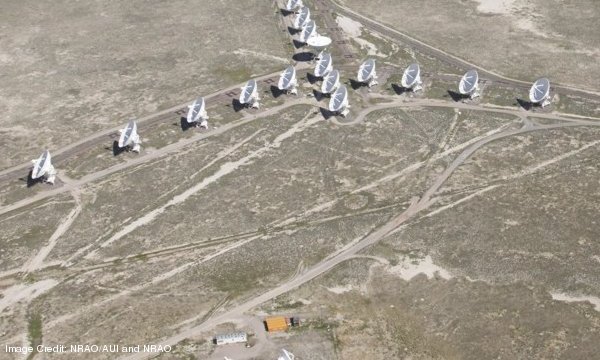
The Very Large Array consists of 27 radio antennas in a Y-shaped configuration. Each antenna is 25 meters in diameter. After more than 20 years of science, people started working on an upgrade for the VLA that would make it more sensitive and accurate. Rick also talks about how he started his career at the VLA and his hobby as a meteorologist providing data to Weather Underground.

Ask an Astronomer

Tim O'Brien answers listener questions.

Odds and Ends

The Leonid Meteor Shower - debris from Comet Tempel Tuttle - is taking place just as this show comes out. See Sky and Telescope for observing tips. You can also check out the Jodrell Bank Meteor Detector and the International Meteor Organization.

Show Credits

Interview:Dr Rick Perley and Roy Smits
Ask An Astronomer:Dr Tim O'Brien
Presenters:David Ault, Megan Argo, Adam Avison, Jen Gupta and Stuart Lowe
Editors:Stuart Lowe and Roy Smits
Segment voice:Ian McDonald
Runner:Chris Tibbs
Website:Stuart Lowe
Cover art:The Very Large Array Credit: NRAO/AUI and NRAO

Comments

  • Comment by Jen Gupta on Nov 16 2009:

    Comments, discussions, questions, corrections, pretty much anything relating to the November Extra show goes here!

  • Comment by Jodatheoak on Nov 22 2009:

    Meteors - if the dust trail the comet leaves flutuates and we can't predict a storm, how did they manage to find the massive ring around Saturn?
    Also when a comet flairs up every now and then like P17/Holmes will we see any meteors from it even though we don't pass thru the comets orbit

  • Comment by EarthUnit on Nov 25 2009:

    Sorry Joda, I can't really help you with this, but my best guess is'.
    Seems like the large ring around Saturn was a bit of a serendipitous find by Spitzer, as Cassini has been in the system a few years now and had not noticed it. (October extra).

    As for seeing bits of a comet (meteors), I don't think you would be able to see them from the Earth surface due to the distortions from the atmosphere, that is unless they hit the atmosphere and flare up :-) I think you would need to send a telescope up to look for them.

    Space is very big
    Bits of comets are very small
    Mathematically speaking very small divided by very big = not much chance :-)

  • Comment by EarthUnit on Nov 25 2009:

    If any one out knows for sure, a free gift of classic Dr Who episodes could be yours !
    http://player.uk.msn.com/sci-fi/

  • Comment by Jodatheoak on Nov 25 2009:

    Great find Earthunit - looks like it has my childhood tv shows...I'm not sure I'll be behind the settee now when i watch :-)

    Not sure my question was put accross right - The big ring around saturn was seen using Spitzer's ifrared detectors.
    http://www.dailymail.co.uk/sciencetech/article-1218675/Saturns-new-ring-discovered-thats-big-contain-billion-Earths.html
    Could you use the same technique for Comet trials or do they not radiate the same way?
    If you could see the heated trail of a comet that would give you a better idea for the meteor showers?

  • Comment by Megan Argo on Nov 26 2009:

    Both Saturn's latest ring and the debris trails left by comets are pretty tenuous collections of material. Dust and bits of rock all have a temperature so will radiate *some* energy at infra-red wavelengths, it's just a matter of how much is emitted, how sensitive your telescope is, and how much stuff you're looking at.

    One of the advantages we have with Saturn's ring is that we're looking through it almost edge-on so, while there aren't many particles per cubic metre, we're looking through a lot of volume. Imagine looking through the smoke from a cigarette side-on, you can see that it's there (it's a lot less tenuous than Saturn's ring!), but imagine looking through it from below - you're looking through more smoke so it's more obvious.

    The trouble with cometary debris is that it's also really tenuous *and* spread out in a much larger volume. Unlike Saturn's ring, we don't have the advantage that we're looking through the thickest part, quite the opposite in fact. I guess in principle you could pick it up with an infra red telescope, but it would have to be phenomenally sensitive to do it. You're right though, Jodatheoak, if we could see them then our models would be much better. The positions of the meteor streams within a given cometary orbit are inferred from observations of visual counts made during meteor showers. No observations -> no model!

  • Comment by EarthUnit on Nov 26 2009:

    Sorry for not understanding the question Joda, it was probably me (been working the night sift again, and not a lot of sleep) .

    Think Megan has won the Dr Who prize :-)
    Thanks for the help Megan

  • Comment by Jodatheoak on Nov 26 2009:

    I'm sure there's a podcast on dust detection, but I could be wrong...I'll let you know.
    Thanks for rply Megan I think I'll look more into this ;-)
    I think its more me than you Earthunit ;-)

Leave a comment on this episode in the forum

Download Options

Subscribe (It's free)